← Back to AI Pulse
Anthropic · Updated February 21, 2026 · Event February 24, 2025

Claude 3.7 Sonnet and Hybrid Reasoning Raised the Bar for Enterprise AI Work

TL;DR for Builders

  • What changed: Claude 3.7 Sonnet pushed forward hybrid reasoning behavior for harder professional workflows.
  • Why it matters: teams now optimize for reliable outcomes, not demo-style outputs.
  • If you are a learner: practice evaluation first, prompting second.
  • If you are a builder: ship one workflow with measurable task-success, latency, and cost.
  • If you ignore this: your skill narrative can look outdated in a reasoning + orchestration hiring market.

Latest editorial update: February 21, 2026. This brief reflects current implementation patterns, hiring signals, and deployment realities as of the update date while preserving the original model-release timeline below.

Why This Matters Now

The Shift (Not the Hype)

This is not about winning one benchmark screenshot. This is about execution under constraints: latency ceilings, cost ceilings, multilingual noise, and workflow reliability. Claude 3.7 Sonnet became important because teams could connect model capability to delivery quality. In India specifically, this matters faster because engineering teams often run with lean margins and aggressive release cycles. A model change is useful only when it improves customer-facing workflows without blowing up unit economics.

Hybrid reasoning modes push teams to build routing discipline between fast and deep-think workloads.

The timing is also structural. Most organizations are moving from AI pilots into accountable production. That means every role is now judged by impact under constraints, not by novelty. In that environment, knowing the release narrative is not enough. You need to prove that you can convert capability into stable product behavior.

What Changed Technically

Capability

  • Higher quality on real task workflows where context and instruction discipline both matter.
  • Better consistency on multi-step outputs compared to older generation patterns.
  • Stronger practical value for productized AI paths, not only one-shot Q&A use cases.

Constraints

  • Performance still depends on careful routing and prompt structure.
  • Cost and latency can spike when teams use a single model for every job.
  • Governance still requires auditability and clear fallback design.

Failure Modes

  • Overconfident wrong outputs in edge-case tasks.
  • Quality degradation when context is noisy or badly structured.
  • Pipeline fragility when teams skip evaluation and rely on anecdotal confidence.

Skill Map: What You Should Learn Because of This

Core Skills (Non-negotiable)

  • Model evaluation with task success rates and failure taxonomy.
  • Prompt structure for workflows, not isolated prompts.
  • Cost-latency-quality trade-off analysis at system level.

Supporting Skills

  • Lightweight evaluation harnesses and regression checks.
  • Human-in-the-loop control design for high-risk actions.
  • Fallback logic for multilingual and noisy inputs.

Anti-Skills (Do Not Overlearn)

  • Prompt tricks without measurement discipline.
  • Single-model architecture dogma.
  • Benchmark parroting without production evidence.

How to Use This (By Level)

Beginner

  • Build a small benchmark around one repeatable workflow.
  • Track failures manually and classify why they happen.

Intermediate

  • Add routing, retries, and guardrails.
  • Measure per-task latency and cost across traffic conditions.

Advanced / Production

  • Implement dual-lane routing for fast vs deep reasoning tasks.
  • Use evaluation gates to decide when deeper reasoning is justified.
  • Track economics by workload tier, not by model average.

Portfolio Ideas That Actually Impress

  • Customer support workflow with failure taxonomy, cost report, and multilingual tests.
  • Internal analyst assistant with benchmark dashboard, routing policy, and rollback mechanism.
  • Public-service simulation flow with audit logs and human escalation path.

Use these as evidence artifacts. Hiring teams trust systems that show judgment under constraints more than flashy demos. Include screenshots of evaluation sheets, error classes, and decision notes on when you intentionally avoided automation.

Career Translation

Resume Bullets

  • Designed evaluation pipeline for Claude 3.7 Sonnet workflows, improving task success with tracked failure classes.
  • Implemented routing policy that reduced AI task cost while preserving response quality targets.
  • Built multilingual guardrails for India-focused user flows with measurable reliability outcomes.

Interview Angles

  • Explain trade-offs you made between latency, quality, and governance.
  • Show one decision where you chose not to use AI and why.
  • Describe how you monitor failure drift after deployment.

Hiring Signals

  • Judgment under constraints.
  • Explicit system-level trade-offs.
  • Ability to run AI as an engineering discipline, not a novelty layer.

Decision Checklist

Use this model if: you serve mixed-language users, can measure outcomes, and can instrument failure monitoring.

Avoid or limit this model if: you need strict determinism, cannot monitor regressions, or cannot justify the cost profile.

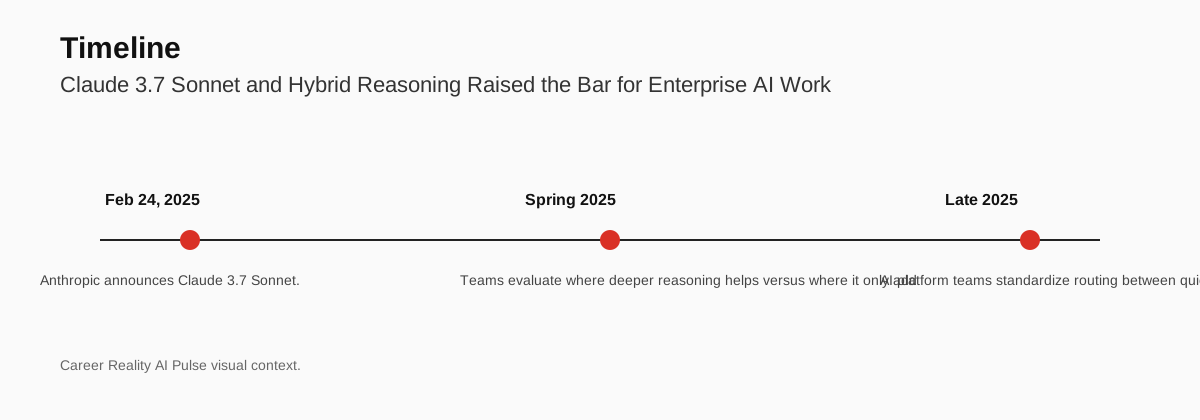
Timeline: Feb 24, 2025: Anthropic announces Claude 3.7 Sonnet. Spring 2025: Teams evaluate where deeper reasoning helps versus where it only adds latency. Late 2025: AI platform teams standardize routing between quick and deep-think models.

Editorial conclusion: Claude 3.7 Sonnet is a real capability step, but the career upside comes from operational competence. The leverage is in turning capability into durable delivery quality.

Review status: this brief has not been re-verified in the last 21 days. Validate critical claims against the original source before making career decisions.

What This Means for Your Career

Quick career conversion notes: - Keep one measurable portfolio artifact per model family. - Build an evaluation log before you optimize prompts. - Learn to explain trade-offs in business terms. - Practice saying no to AI where determinism is mandatory.

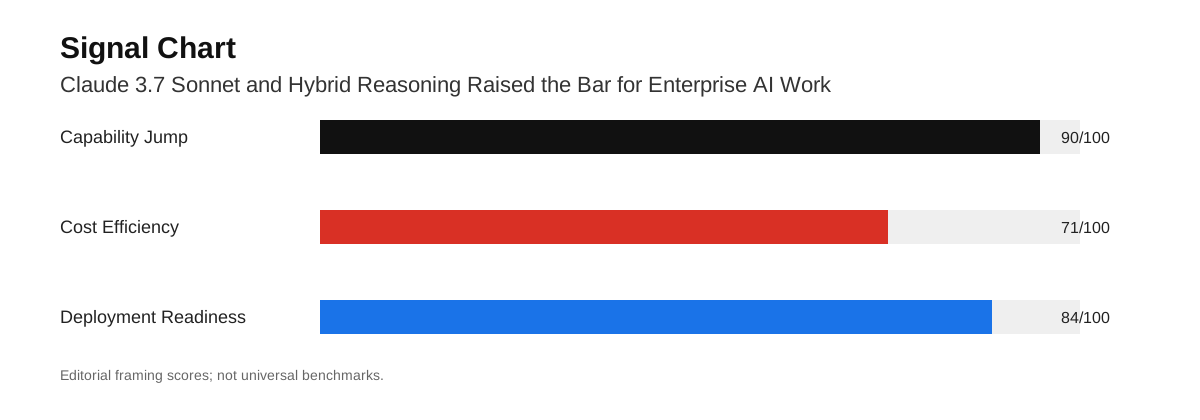
In editorial terms, separate capability, reliability, and economics. Capability tells you what the model can do in ideal settings. Reliability tells you what it continues doing under noisy conditions. Economics tells you whether that behavior is sustainable at your actual traffic, latency target, and budget ceiling.

In editorial terms, separate capability, reliability, and economics. Capability tells you what the model can do in ideal settings. Reliability tells you what it continues doing under noisy conditions. Economics tells you whether that behavior is sustainable at your actual traffic, latency target, and budget ceiling.

In editorial terms, separate capability, reliability, and economics. Capability tells you what the model can do in ideal settings. Reliability tells you what it continues doing under noisy conditions. Economics tells you whether that behavior is sustainable at your actual traffic, latency target, and budget ceiling.

Where This Sits in AI Evolution

This article sits in the 2025 phase: Reasoning + Agent Systems. Teams shifted from prompt demos to orchestrated, evaluation-driven AI systems.
2017
Transformer Era Begins
2020
Foundation Models Expand
Late 2022
Chat UX Breakout
2023
Copilot Adoption Wave
2024
Multimodal + Open Models
2025
Reasoning + Agent Systems
Now (2026)
AI as Core Operating Layer

Visual Story

Timeline for Claude 3.7 Sonnet and Hybrid Reasoning Raised the Bar for Enterprise AI Work Signal chart for Claude 3.7 Sonnet and Hybrid Reasoning Raised the Bar for Enterprise AI Work
Calculator
Reality Check
Layoff Radar
Salary Drop